
Returning to Secure Ground
Many mothers are responding to real conditions of instability. Relational strain. Systemic failure. Ecological crisis. When attachment systems are activated in environments that cannot reliably hold them, distress is not a sign of weakness. It is the nervous system seeking safety.
Current Offerings

Motherhood is Attachment
Motherhood is not only a role or identity. It is an attachment relationship that reorganizes the body, the nervous system, and the way safety is perceived.
For many mothers, this reorganization happens alongside trauma, separation, loss, or dislocation. When caregiving unfolds without reliable support, attachment needs do not disappear. They intensify.
Healing does not come from overriding these needs. It comes from restoring secure bases where truth can be held without fragmentation. This may happen through relationship with others, with place, and with the living world itself.
The Mother Tree Method™ understands healing as the restoration of attachment rather than self correction. It offers a way of returning to parts of yourself that already know how to seek safety, connection, and continuity.
The Mother Tree Method™
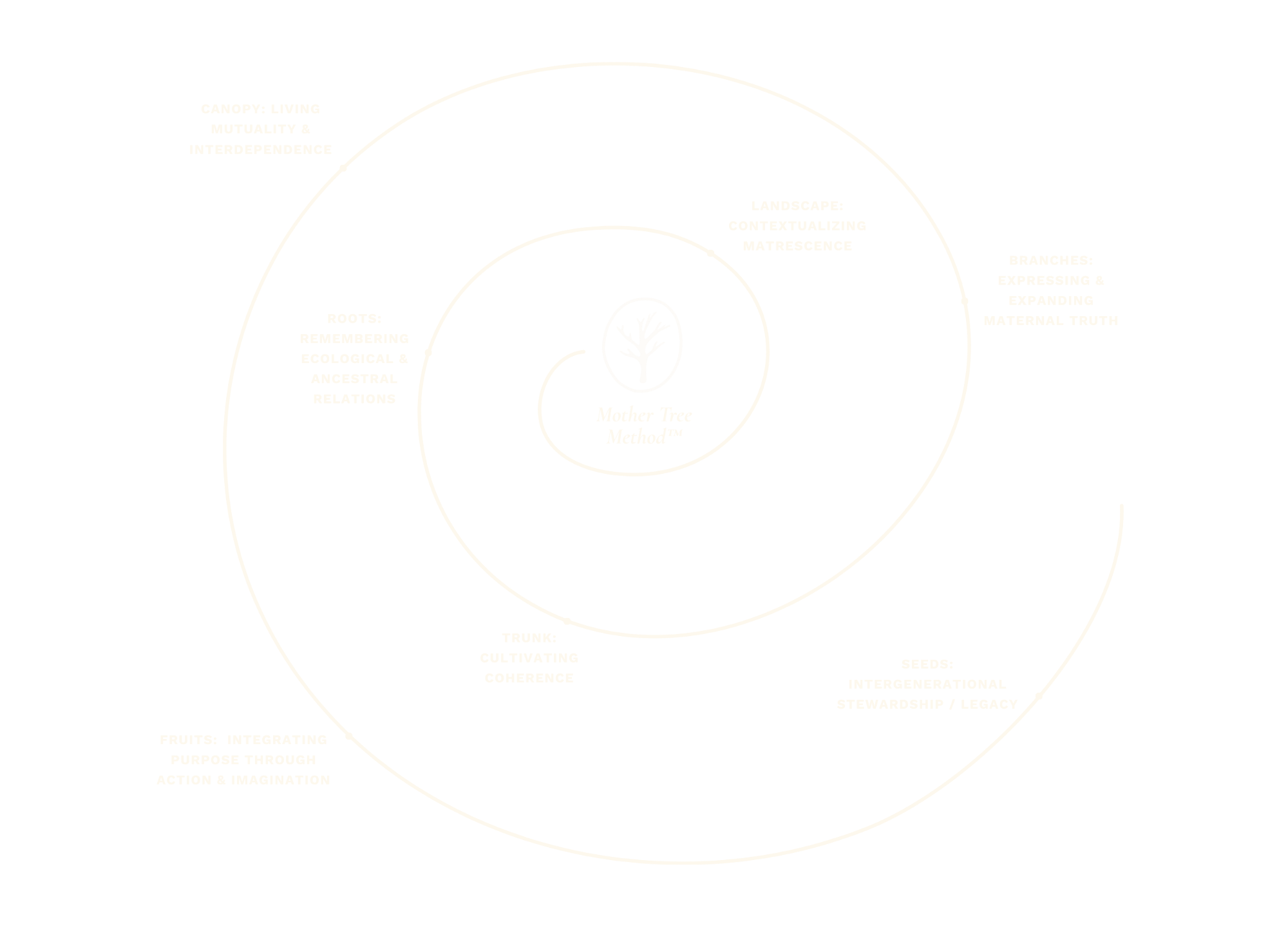
The Mother Tree Method™ is an attachment informed, ecological framework for understanding maternal ecodistress. It unfolds across seven developmental stages that reflect how mothers build secure attachment over time with self, others, and the Earth.
These stages recognize the Earth as a potential secure base when human systems have failed to provide one. The method holds both the risks and the protective capacities of ecological connection during matrescence, supporting repair rather than avoidance.
1. Learn
This self paced course introduces the Mother Tree Method™ as a framework for understanding maternal trauma, ecodistress, and attachment in ecological context.
Through maternal ecopsychology, somatic awareness, and guided reflection, participants learn to recognize distress as adaptive intelligence, restore trust in bodily perception, and rebuild a sense of relational safety.
This course does not ask mothers to manage symptoms in isolation. It offers language, structure, and practice for understanding what their nervous systems have been responding to all along.
Waitlist for Notification of Launch
2. Deepen
Individual work offers a contained, relational space for mothers navigating trauma, separation, or profound reorganization.
Across seven guided sessions, we work with lived experience through an attachment lens that attends to body, history, and environment together. The focus is not performance or progress, but integration and repair.
This work supports the gradual restoration of secure attachment and steadier capacity, grounded in relationship rather than self surveillance.
3. Engage
For mothers who wish to work alongside others, this pathway offers facilitated spaces for shared learning grounded in the Mother Tree Method™.
These gatherings emphasize continuity, shared language, and collective orientation. They are structured to support attachment repair without requiring disclosure or comparison, allowing participants to remain rooted in their own pace and boundaries.
Coming soon: The Mother Tree Method™ book
Mother Juniper: Lessons on Mothering in Climate Crisis
This book explores maternal ecodistress as an embodied response to ecological crisis and as an expression of disrupted attachment rather than individual disorder.
Drawing from ecopsychology, trauma theory, attachment research, and lived maternal experience, it offers a developmental framework for understanding how care, belonging, and recovery unfold when the world itself feels unreliable.


I am a maternal mental health ecotherapist and maternal ecopsychology scholar. My work integrates attachment theory, ecological psychology, and trauma informed care to support mothers through periods of rupture and repair.
For over two decades, I have worked with mothers navigating trauma, caregiving complexity, and systemic strain. The Mother Tree Method™ emerged from this work as a way of understanding maternal distress as meaningful signal and attachment seeking rather than failure.
Learn MoreWhat Mothers are Saying
“The group shifted my understanding of motherhood by empowering me to honor this new stage of my life as an opportunity to explore and reconnect with my ecological self and navigate how it is evolving.”
“I’m thinking of motherhood more as a process and a way of engaging with the world. This has been pretty eye-opening, because beforehand I was applying a much more literal definition related to directly caring for my child. It’s allowed me to accept that my whole being has changed, including how I perceive and relate to nature.”
“It very much opened my eyes to the overlap between the cycles of nature and becoming a mother. It provided space for more expansive thought around how nature impacts how we mother and also how we transition into motherhood.”
“Validated the extreme transformation that can happen when you become a mother—and the ways in which that can be devalued by external forces in society.”
“I didn’t know that the brain changes in response to motherhood. This helps explain a lot of huge shifts that have taken place in my internal world.”
“I am more aware of different ways other mothers are living with the reality of climate change, and that has made me more compassionate. I feel less lonely. I have a sense of being part of a web of mothers. I am thinking more and more concretely about the burden of motherhood, socially, emotionally.”
“Through this group, I have begun to understand and see more that so many other women who are part of motherhood experience and have many similar feelings that I have. So many times, it feels like I am the only one, or that I am alone. But being in this group has really made me realize that the feelings and experiences that I have experienced are very common.”
“[The group] made me realize how important a fellow community of mothers is—how many of us are having similar thoughts and feelings that we don’t feel we have an outlet for.”
“[The group] has been helpful in speaking some of the frustrations I’m feeling. Moms are busy. Depression is real. Finding motivation to do anything beyond daily life survival is challenging.”
“Thank you so much. It was a very deep experience taking part in this group. I learned a lot and think of the learnings often in my daily life.”
What 1:1 Clients Are Saying
“I felt heard right away. It was just the first session, but I could already feel the space opening for something real.”
“In every session, the insight landed. I left feeling more grounded, more seen, and more capable.”
Frequently Asked Questions
Who is this for?
What is the Mother Tree Method™?
How does ecological development support mothers?
What will I experience if I engage with the Mother Tree Method™?
How can I begin working with the Method?
Do I need all three pathways to benefit?
How is this different from other maternal support programs?
Subscribe to the Mother Tree Journal
Reflections, research, and writing on maternal attachment, ecodistress, and ecological belonging.